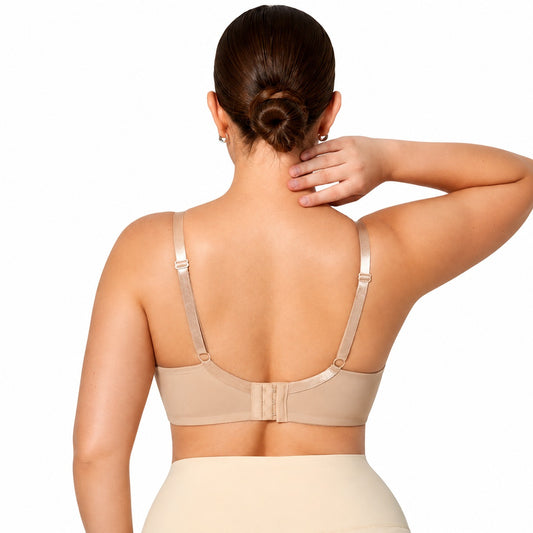
How to Measure Your Bra Size at Home: A Step-by-Step Guide
Have you ever worn a bra that felt comfortable in the morning but started digging into your shoulders or feeling tight by the end of the day?
Your bra size could be part of the reason.
Many women continue wearing the same size for years, even when their bodies and fit preferences change. Weight fluctuations, hormonal changes, pregnancy, and different bra designs can all affect how a bra feels.
The good news is that you can measure yourself at home with a soft measuring tape and a few simple steps. While measurements are a useful starting point, the right fit also depends on the bra style and the brand's sizing chart.
In this guide, we'll explain how to measure your bra size at home, understand your measurements, and recognise the signs of a better fit.
Why Your Correct Bra Size Matters
Your bra should feel supportive without becoming something you constantly need to adjust.
A well-fitting bra can help you:
-
Feel more comfortable throughout the day
-
Get better support from the band and cups
-
Reduce straps digging into your shoulders
-
Achieve a smoother appearance under clothing
-
Find a fit that feels secure without being restrictive
The goal isn't simply to find a number and letter. It's to find a bra that works comfortably with your body.
What You'll Need to Measure Your Bra Size
Before you begin, keep these essentials ready:
-
A soft measuring tape
-
A non-padded or lightly lined bra
-
A mirror
-
Your phone or notebook to record the measurements
Stand naturally in front of a mirror. Keep the tape level around your body, and avoid pulling it so tightly that it compresses your skin.
For the most useful starting measurements, measure directly against your body or while wearing a lightly lined bra that doesn't significantly change your natural shape.
Step 1: Measure Your Underbust for Band Size
The band sits around your ribcage and provides much of your bra's support.
Here's how to measure it:
-
Place the measuring tape directly underneath your bust.
-
Keep the tape snug against your body without digging into your skin.
-
Check that the tape is straight and parallel to the floor.
-
Breathe normally and record the measurement in inches.
For example, if your underbust measures approximately 34 inches, a size 34 band may be a useful starting point.
However, don't automatically round every measurement to the nearest even number. Different brands use different sizing methods, so check the brand's size chart before choosing your band size.
Step 2: Measure Your Bust
Next, measure around the fullest part of your bust.
Follow these steps:
-
Wrap the tape around the fullest part of your bust.
-
Keep it level across your back and chest.
-
Make sure the tape rests gently against your body without squeezing.
-
Record the measurement in inches.
For example, your bust measurement might be 37 inches.
Keep both measurements handy because you'll use them together to estimate your starting bra size.
Step 3: Estimate Your Cup Size
Your cup size is related to the difference between your bust measurement and your band measurement.
A commonly used approximate guide is:
| Difference | Approximate cup size |
|---|---|
| 1 inch | A |
| 2 inches | B |
| 3 inches | C |
| 4 inches | D |
| 5 inches | DD or E, depending on the sizing system |
| 6 inches | DDD or F, depending on the sizing system |
These measurements are only a starting guide. Cup-sizing conventions differ between brands and countries, so use the specific brand's chart whenever possible.
Example: Estimating a Bra Size
Let's say your measurements are:
-
Underbust: 34 inches
-
Bust: 37 inches
-
Difference: 3 inches
Using the approximate guide above, 34C may be a starting size to try.
That doesn't guarantee a perfect fit. The cup shape, band tension, fabric, and bra design can all affect how the size feels on your body.
Step 4: Check How the Bra Fits
Measurements can help you choose a starting size, but trying on the bra is an important part of the process.
Use this checklist to assess the fit:
-
Band: It should feel firm and comfortable, sitting level around your body.
-
Cups: They should contain your breast tissue without noticeable overflow or excessive empty space.
-
Straps: They should stay in place without digging painfully into your shoulders.
-
Centre front: On many traditional bra styles, the centre should sit close to your chest, although the design can affect this.
-
Movement: Raise your arms and move naturally. The bra should remain reasonably secure.
-
Comfort: You should be able to breathe and move without feeling excessively squeezed.
A bra doesn't need to feel tight to be supportive. Comfort and stability matter more than forcing yourself into a particular size.
Signs Your Current Bra May Not Fit Properly
Your everyday bra can give you clues that it's time to reassess the size.
1. The Band Rides Up Your Back
If the back band consistently moves upwards, it may be too loose or the bra may have stretched with use.
2. Your Breast Tissue Spills Out of the Cups
Overflow at the top, sides, or centre can indicate that the cups are too small or don't suit your breast shape.
3. The Cups Wrinkle or Have Excess Space
Visible gaps or persistent wrinkles may indicate that the cups are too large or have a shape that doesn't match your body.
4. The Straps Dig Into Your Shoulders
Straps that cause discomfort may be adjusted too tightly, or the band may not be providing enough support. Check both before changing sizes.
5. The Band Feels Painfully Tight
A band should feel secure, not painful. If it restricts your breathing, digs into your skin, or causes ongoing discomfort, try another size or style.
6. You Keep Adjusting Your Bra
If the band, straps, or cups repeatedly shift throughout the day, the size or design may not be right for you.
Common Bra Measurement Mistakes to Avoid
Small measurement errors can lead to a less comfortable fit. Avoid these common mistakes:
-
Measuring over thick clothing
-
Pulling the measuring tape too tightly
-
Allowing the tape to slope across your back
-
Measuring over heavily padded cups that alter your bust measurement
-
Assuming your bra size stays the same forever
-
Choosing the same size in every brand without checking its chart
-
Ignoring discomfort simply because the label says it's your usual size
Measure calmly and record the results before selecting a bra.
When Should You Measure Your Bra Size Again?
Your measurements and fit preferences can change over time. Consider measuring again if you notice changes after:
-
Weight gain or weight loss
-
Pregnancy or breastfeeding
-
Hormonal changes
-
Changes in exercise or daily activity
-
A noticeable change in how your usual bras fit
You can also check your measurements every 6–12 months as a practical reminder, although there is no fixed schedule that applies to everyone.
What Are Bra Sister Sizes?
Sister sizes are bra sizes with similar cup volumes but different band and cup labels.
For example, 34C and 36B are commonly considered sister sizes in many sizing systems. Similarly, 32D and 34C are often sister sizes.
Sister sizing can help when the cup volume feels right but the band doesn't.
-
If the band feels too tight, a sister size with a larger band and smaller cup may be worth trying.
-
If the band feels too loose, a sister size with a smaller band and larger cup may be worth trying.
Always check the cup fit again when changing sizes. Sister sizes can have similar cup volumes, but they won't necessarily feel identical in every bra design.
Frequently Asked Questions
Can I measure my bra size accurately at home?
Yes. Home measurements can give you a useful starting point. Trying on the bra and checking the brand's size chart will help you make a more informed choice.
Should I measure while wearing a bra?
A non-padded or lightly lined bra that doesn't compress or significantly reshape your bust can work well. You can also measure directly against your body.
Why does my bra size differ between brands?
Brands may use different sizing conventions, patterns, cup shapes, and fit preferences. That's why checking the size chart for each brand is important.
Is it normal for one breast to be larger than the other?
Yes. Some difference between breasts is common. Choose a bra that accommodates the larger breast comfortably, and adjust the straps if needed.
What if my measurements fall between two sizes?
Check the brand's sizing guidance and, if possible, try both sizes. Consider how the band and cups feel rather than choosing solely by the measurements.
Does the right bra size guarantee comfort?
Not always. Even a correctly sized bra can feel uncomfortable if its shape, fabric, straps, or construction don't suit your body. Both size and design matter.
Final Thoughts
Measuring your bra size at home doesn't need to be complicated. With a soft measuring tape, two basic measurements, and a little attention to fit, you can find a more informed starting point.
Remember, your bra size is a guide—not a rule you have to follow forever. What matters is finding innerwear that feels secure, supportive, and comfortable throughout your day.
At Velora, we believe everyday comfort starts with understanding your fit and choosing innerwear that works for you. Take your measurements, check the relevant size chart, and give yourself the freedom to choose comfort over guesswork.